What We Offer

Seven services, built around measurable carbon performance and product-level proof.

From carbon footprinting, ESG assessment, and operational efficiency for domestic operations to EU export compliance, Digital Product Passport readiness, and hands-on lab testing for Iron & Steel and Textiles — organized below by what each service actually covers.

How We Work

From baseline to full compliance, in four steps

01

Assess

Measure your product and organizational carbon footprint against ISO 14067, PEFCR, and related methodologies.

02

Document

Digitize records and build the structured data every CBAM, DPP, and ESG disclosure ultimately depends on.

03

Certify

Prepare for third-party certification and validation against the standards relevant to your sector.

04

Comply & Monitor

Stay ahead as CBAM, ESPR, and CPR requirements evolve, with guidance updated as regulations firm up.

Core Services

Explore each service

Export Market Access and Product Testing & Verification expand into their sub-services — click a row to open it.

01 — Compliance

Export Market Access

Helping Iron & Steel and Textile exporters meet the technical, regulatory, and documentation requirements to enter and remain competitive in the EU market — from carbon reporting to full product passport readiness.
EU CBAM Compliance
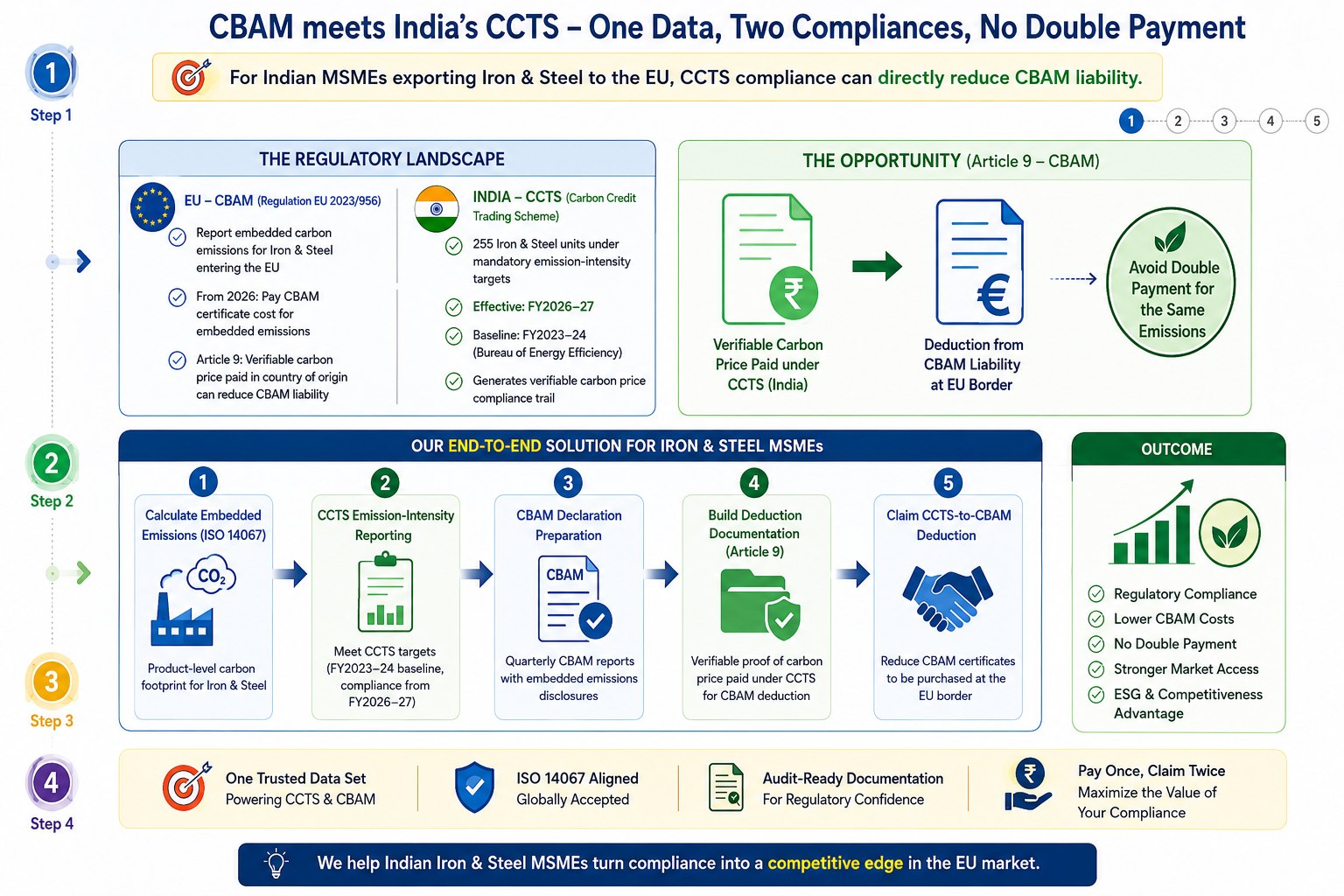
Iron & Steel CBAM meets India's CCTS — one data set, two compliances: verifiable carbon price paid under CCTS in India can be deducted from CBAM liability at the EU border under Article 9.
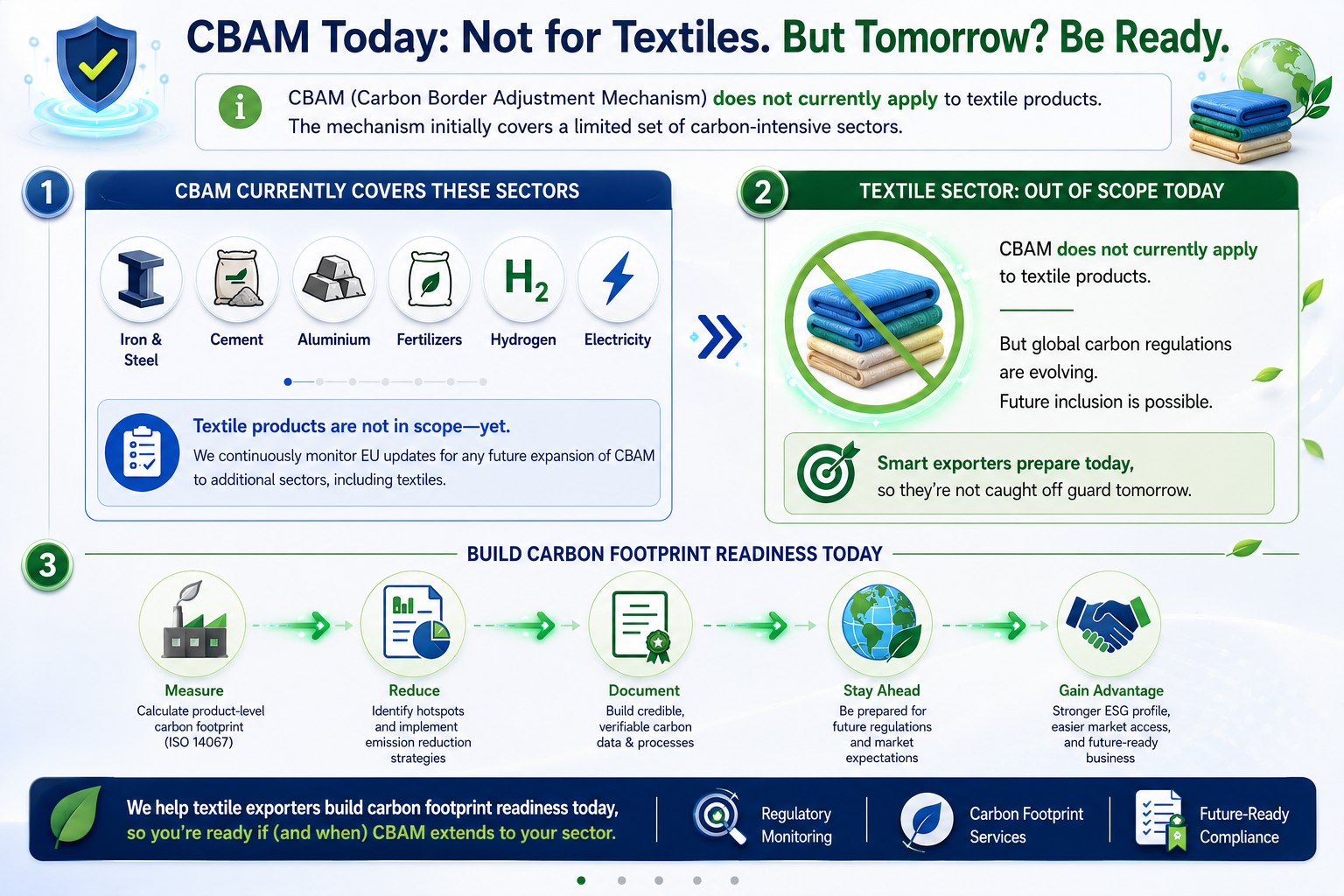
Textiles CBAM today does not apply to textile products — it currently covers iron & steel, cement, aluminium, fertilizers, hydrogen, and electricity. Textile exporters should build carbon footprint readiness now.
EU ESPR Compliance

ESPR (Regulation (EU) 2024/1781) is the framework regulation that will define binding ecodesign and Digital Product Passport requirements through sector-specific delegated acts. We map your current product data against the likely requirements — durability, recyclability, carbon/environmental footprint, substances of concern — and build a phased readiness roadmap ahead of each sector's delegated act.
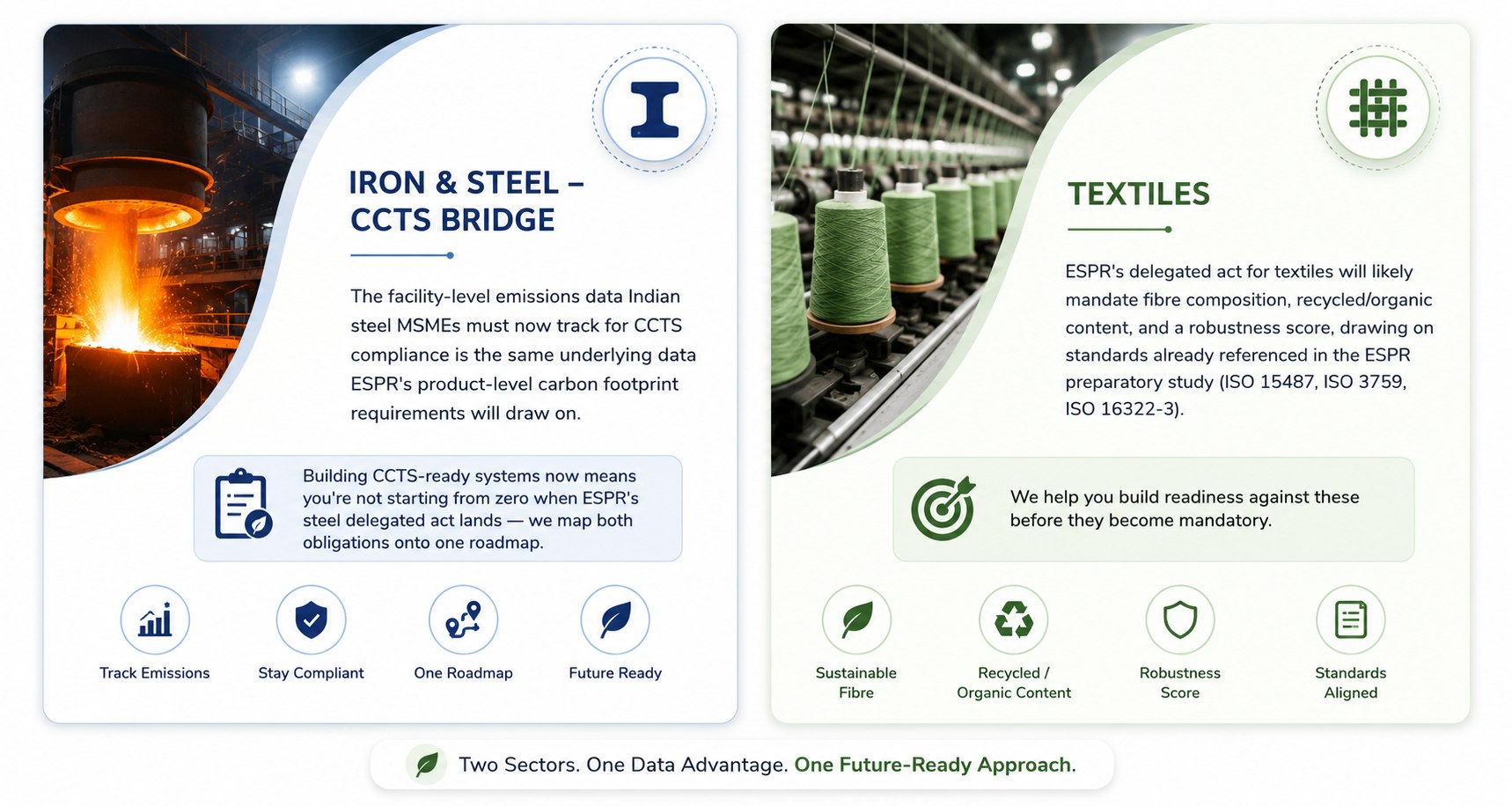
Iron & Steel — CCTS Bridge: the facility-level emissions data Indian steel MSMEs must track for CCTS compliance is the same data ESPR's product-level carbon footprint requirements will draw on. Textiles: ESPR's delegated act for textiles will likely mandate fibre composition, recycled/organic content, and a robustness score, drawing on ISO 15487, ISO 3759, and ISO 16322-3.
EU CPR Compliance
Iron & Steel For construction-grade steel, the Construction Products Regulation ((EU) 2024/3110) governs Declarations of Performance and CE marking. We align product testing, technical documentation, and performance declarations with CPR, and prepare this data for future DPP integration.
Textiles — Not Applicable CPR applies specifically to construction products and does not extend to textiles. This service is not applicable for textile exporters.
Digital Product Passport Readiness
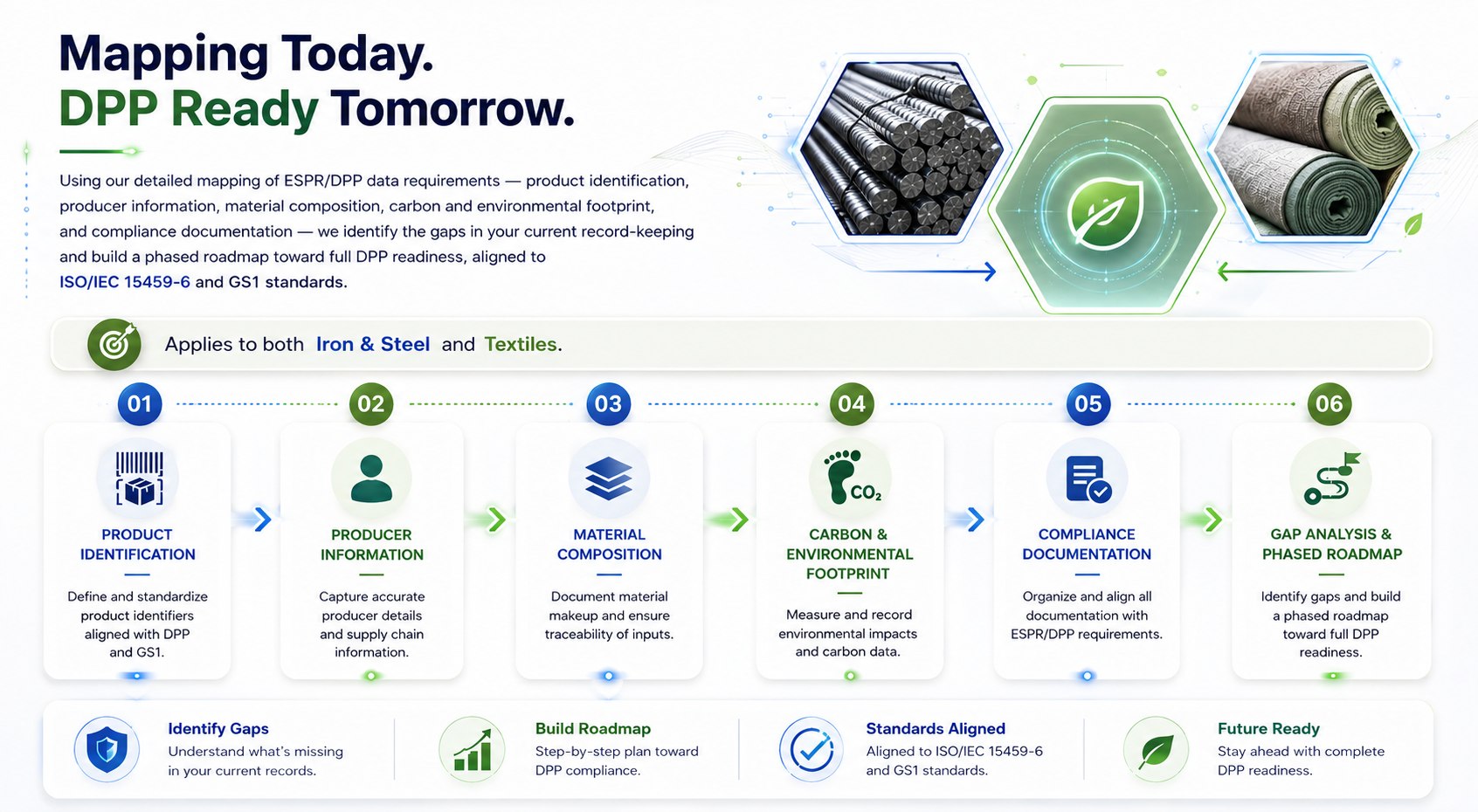
Mapping Today. DPP Ready Tomorrow. Using our detailed mapping of ESPR/DPP data requirements — product identification, producer information, material composition, carbon and environmental footprint, compliance documentation, and gap analysis and phased roadmap — aligned to ISO/IEC 15459-6 and GS1 standards. Applies to both Iron & Steel and Textiles.
Sustainability Certification Readiness
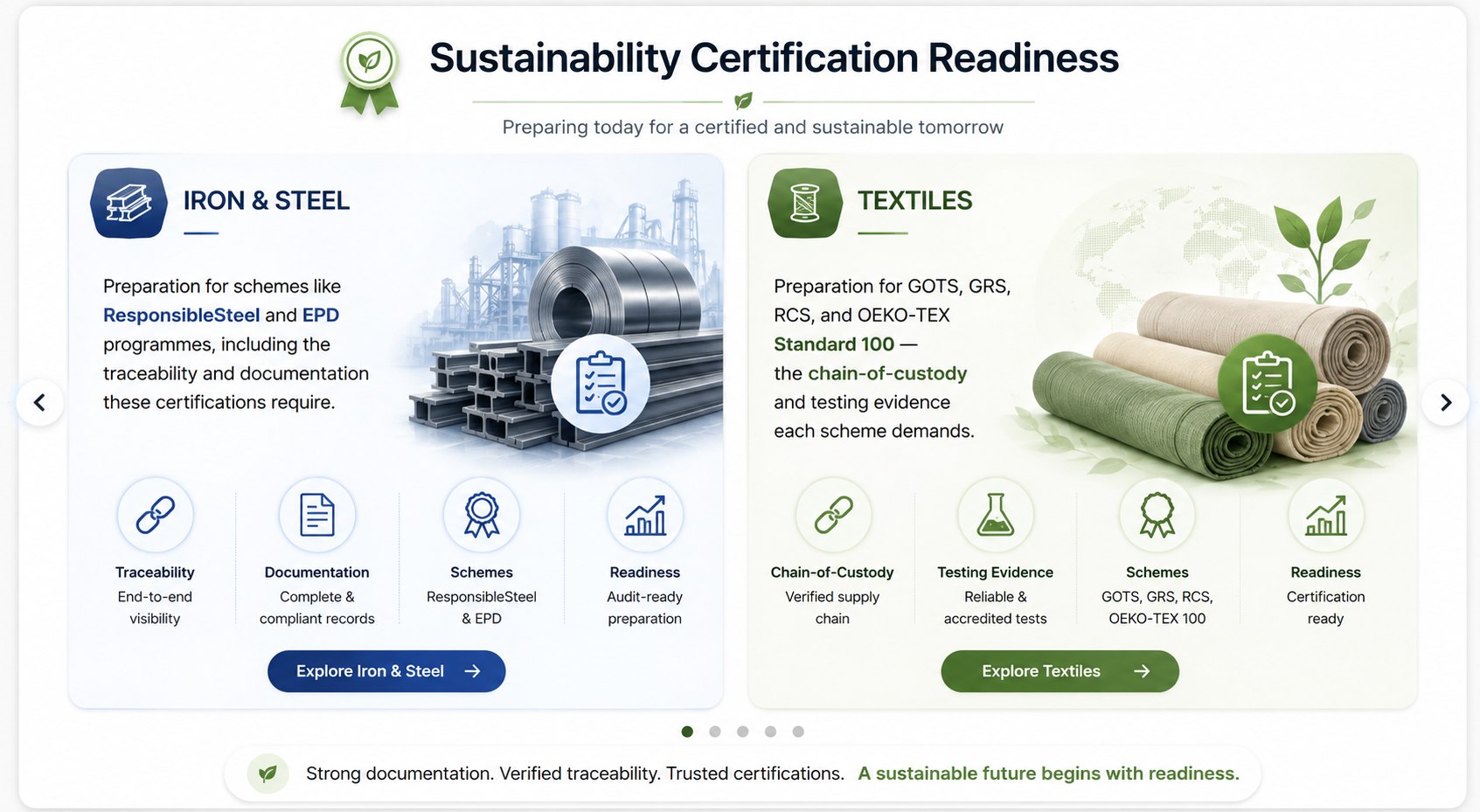
Iron & Steel: preparation for schemes like ResponsibleSteel and EPD programmes, including the traceability and documentation these certifications require. Textiles: preparation for GOTS, GRS, RCS, and OEKO-TEX Standard 100 — the chain-of-custody and testing evidence each scheme demands.
02 — Assessment

Product Carbon Footprint

We calculate product-level carbon footprints using internationally recognized methodology — ISO 14067 life cycle assessment for iron & steel, and PEFCR (Product Environmental Footprint Category Rules for Apparel & Footwear) for textiles — producing a verifiable, standards-aligned figure ready for CBAM reporting, EPD certification, or DPP disclosure.

03 — Assessment

Environmental Footprint

Beyond carbon alone, we assess your product's broader lifecycle environmental impact — EN 15804 for construction-grade steel EPDs, PEFCR's single-score methodology for textiles — supporting Environmental Product Declarations and upcoming ESPR disclosure requirements.

04 — Consultancy

Operational Optimization Consulting

We identify inefficiencies in resource use, energy consumption, and production processes, turning sustainability compliance work into measurable operational savings and improved margins — not just a cost of doing business in the EU market.

05 — Assessment

ESG Assessment

A structured assessment of your organization's environmental, social, and governance performance, benchmarked against recognized frameworks, to support investor reporting, stakeholder disclosure, and continuous improvement.

06 — Consultancy

Information Digitization

We help manufacturers move from paper-based Mill Test Certificates, lab reports, and compliance records to structured digital data systems — the foundation every DPP, CBAM, and ESG disclosure ultimately depends on.

07 — Verification

Product Testing and Verification

Hands-on and third-party verified testing, organized by sector.
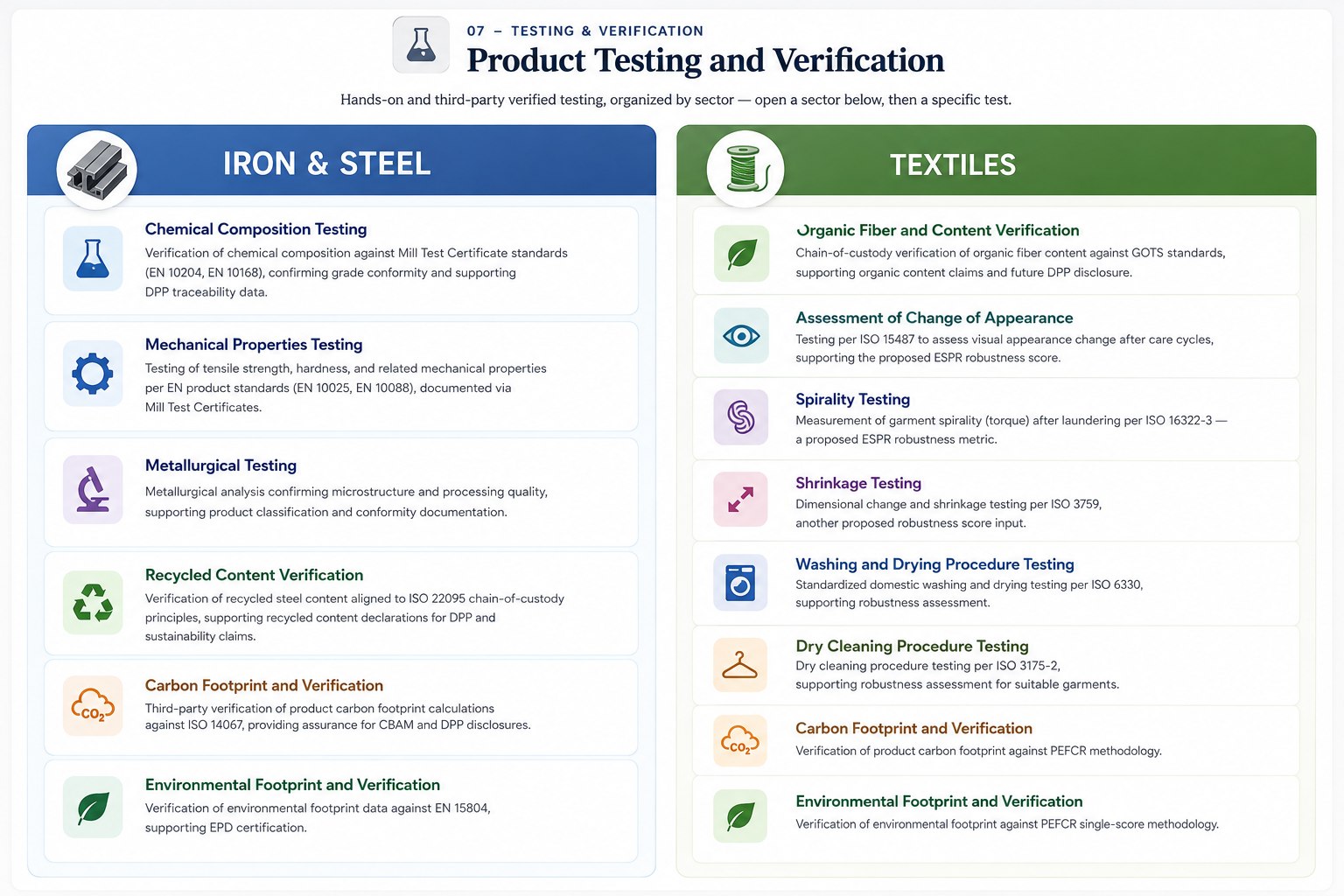
Product Testing and Verification, by sector. Iron & Steel: Chemical Composition Testing (EN 10204, EN 10168), Mechanical Properties Testing (EN 10025, EN 10088), Metallurgical Testing, Recycled Content Verification (ISO 22095), Carbon Footprint and Verification (ISO 14067), Environmental Footprint and Verification (EN 15804). Textiles: Organic Fiber and Content Verification (GOTS), Assessment of Change of Appearance (ISO 15487), Spirality Testing (ISO 16322-3), Shrinkage Testing (ISO 3759), Washing and Drying Procedure Testing (ISO 6330), Dry Cleaning Procedure Testing (ISO 3175-2), Carbon Footprint and Verification (PEFCR), Environmental Footprint and Verification (PEFCR).
A note on regulatory timing: CCTS coverage for the Iron & Steel sector reflects a draft notification issued in June 2026 — dates, thresholds, and the CCTS-to-CBAM deduction mechanics may shift before final rules are confirmed. ESPR's sector-specific delegated acts for both Iron & Steel and Textiles are also still being finalized. We track these developments and update client guidance as regulations firm up — get in touch for the current status on any of the above.
Who We Work With

Sectors we serve

We work primarily with Indian MSME exporters navigating EU market access — currently focused on two sectors.

Iron & Steel

Mill Test Certificate–backed testing, CBAM and CCTS-aligned carbon reporting, CPR compliance for construction-grade products, and Digital Product Passport readiness for structural and stainless steel manufacturers.

Textiles

Fibre and organic content verification, robustness testing (spirality, shrinkage, wash/dry cycles), PEFCR-based carbon and environmental footprinting, and certification readiness for GOTS, GRS, RCS, and OEKO-TEX.
Not sure which service fits?

Tell us where you're starting from.

Talk to Our Team